
Aquaponiksysteme · Double Loop
Fully Decoupled One-Way System
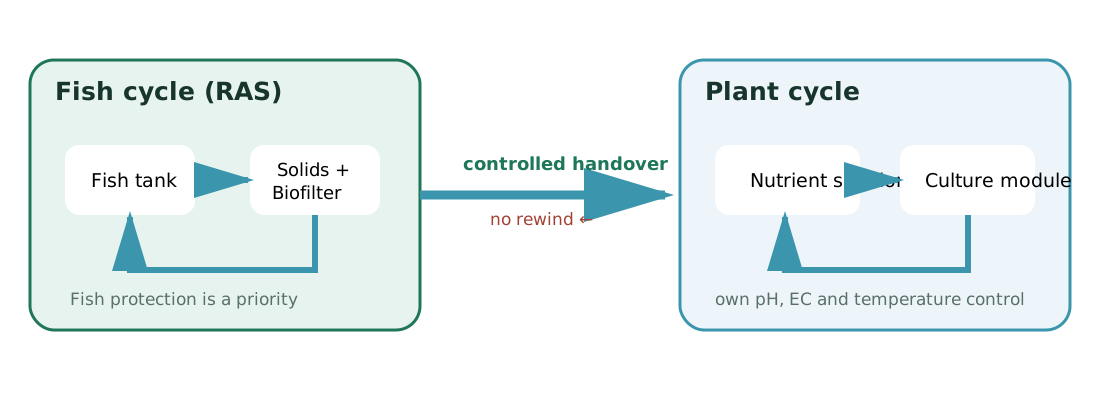
Zwei eigenständige Wasserkreisläufe mit kontrollierter Übergabe zum Pflanzenbereich und ohne Rückführung zum Fischkreislauf.
Clearly define system boundaries
What is a fully decoupled one-way system?
The fish sector operates as an independent recirculating aquaculture system (RAS). The plant area has its own hydroponic circulation. A defined amount of treated fish water or nutrient solution obtained from it is transferred into the plant cycle. From this transfer point onwards, it is cultivated on the plant side and is not returned to the fish cycle.
Biologically independent
Solids separation, biofiltration, ventilation, temperature control and circulation ensure fish farming independent of plant operations.
Directed and balanced
Water or processed nutrient fractions are transferred based on quantity or quality. Backflow is hydraulically excluded.
Can be optimized separately
pH, conductivity, temperature and supplementary fertilization can be adjusted to the culture and growth phase.
Balance water and material flow separately
Water, solid and nutrient pathway
Balanced transfer
The amount transferred is based on the need for water changes, plant consumption, storage capacity and permissible concentration.
Not transferred without checking
Depositable substances are removed on the fish side. Separate mineralization can recover nutrients; Raw mud does not belong directly in sensitive plant modules.
Usable, but not complete
Fish water provides nitrogen compounds in particular. The ratio of all elements necessary for plants does not automatically correspond to the culture requirements.
Open endpoints
Harvest, evaporation, transpiration, flushing and discarded solution exit the system. Disposable therefore does not mean a closed material cycle.
Each circuit carries out its own core functions
Required components
Fish side
- Fish tank, swamp and safe circulation
- mechanical solids separation
- sufficiently sized biofilter
- Ventilation or oxygen entry
- Temperature and water level guidance
- Emergency ventilation, alarm and bypass
Plant page
- Nutrient solution container with its own circulation
- suitable culture module: NFT, DWC, substrate or vertical
- Filtration suitable for the module
- Aeration of the root zone
- Dosage and pH correction
- Drainage, overflow and hygienic discharge
Fish protection remains a task in its own right
Biofiltration, nitrification and oxygenation
Limit solids
Feces, leftover food and biofilm increase oxygen requirements and can put strain on filters and plant roots. They are detected early.
TAN oxidize
Ammonia-oxidizing microorganisms form nitrite; Nitrite oxidizers, including Nitrospira, form nitrate. Nitrification requires oxygen and alkalinity.
Assess NH₃ risk
The proportion of more toxic uncharged ammonia increases with pH and temperature. TAN must therefore be evaluated together with both variables.
The plants are not a necessary emergency cleanup for the fish cycle. Conversely, the plant side must not be dependent on sufficient supply water with the appropriate nutrient composition being available at all times.
Fish residues do not automatically become complete fertilizer
Mineralization and nutrient management
Separate mineralization
Sludge treatment is operated as a separate process with a defined residence time, oxygen supply and separation.
Add analytically
Potassium, calcium, iron or other elements are only supplemented according to measurement, culture requirements and product approval.
Maintain pH in a plant-appropriate manner
The lack of recirculation allows a lower plant pH without directly affecting the fish and biofilter cycle.
Balance salts
EC is a sum signal and does not replace ion analysis. Sodium, chloride and unabsorbed ions can accumulate.
Design biological load and plant consumption decoupled
Design and handover strategy
Determine fish load
Maximum realistic feed rate, fish species, biomass, temperature and feed composition form the basis for solids, TAN and oxygen load.
Record plant requirements
Culture, area, climate, growth phase, transpiration and target EC determine water and nutrient requirements.
Limit transfers
Minimum and maximum are derived from RAS water balance, plant container, holding capacity and allowable nutrient concentration.
Mix and correct
Transferred water is analyzed before or in the plant container, tempered and replenished if necessary.
Buffer deviations
Storage capacity and alternative water or nutrient supplies bridge fluctuating production and different harvest cycles.
Validate real operation
Amounts, concentrations, plant uptake, discharges and RAS water changes are measured and updated as a material balance.
Strictly assign measuring locations
Water quality, measurement and control
| Measurand | Fish cycle | Plant cycle | Operational significance |
|---|---|---|---|
| pH | Fish species, biofilter and alkalinity | Nutrient availability and culture goal | Separate regulation is a main advantage |
| Temperature | Fish performance, oxygen and NH₃ content | Root health and plant development | Transfer water can be tempered |
| Oxygen | Fish, biofilters and organic load | Roots and microbial activity | Both circuits need their own protection |
| TAN / Nitrite | immediate fish and biofilter control | Evidence of residual nitrification and organic processes | Document the unit and sample location |
| EC / ions | Observe spring water and salt accumulation | Maintain nutrient solution and check individual ions | EC alone does not prove a balanced diet |
| Volume | Balance withdrawal and make-up water | Balance transpiration, leakage and discharge | Use flow meter or container balance |
Weigh optimization against additional effort
Advantages and limitations
Possible benefits
- separate pH and temperature control
- Plant-specific nutrient supplementation with no return risk for fish
- Fish and crop production independently scalable
- lower risk of introducing plant-based agents into the fish cycle
- Production cycles can be planned separately
- RAS water changes are used as a resource
Limits and requirements
- two complete revolutions increase the technical and measurement effort
- no plant-based water purification for the fish cycle
- Transfer supply and plant demand can differ
- Nutrient supplementation and occasional solution replacement remain possible
- Storage, balancing and backflow prevention required
- additional hygiene and disposal routes
Control disturbances at the system boundary
Incidents, biosecurity and redundancy
Reflux
A missing or leaking non-return valve can introduce concentrated nutrient solution onto the fish side. Air gap or physical separation is more robust than a single valve.
Transfer failure
The plants need water reserves; the RAS must be able to safely handle excess replacement or flushing water.
Overdose
Incorrect pH or fertilizer dosage is limited by dosage limits, plausibility checks and separate storage materials.
Oxygen failure
Emergency ventilation and alarms are evaluated separately for both circuits. A functioning plant circulation does not save a failed fish circulation.
- Secure the fish circuit and emergency ventilation first.
- Block transfer and physically exclude backflow.
- Evaluate the affected circuit using your own measuring points.
- Treat discarded solution and contaminated substances in a controlled manner.
- Only transferred again after documented release.
For controlled, professionally managed production
Suitability, system sizes and typical applications
Particularly suitable
For systems in which fish and plant species require significantly different target values, production areas are spatially separated or precise plant-based nutrient management is required.
Conditionally suitable
For small demonstration and hobby systems when the additional technical and analytical effort does not provide a clear benefit compared to a coupled system.
Typical application
Professional greenhouse production, research, modular expansions of existing RAS systems and locations with plannable water and nutrient management.
The architecture is not automatically “better”. It makes sense when the gain in process control justifies the additional investment, measurement, maintenance and accounting effort.
Do not mix system architecture and plant module
Connect to media bed, NFT, DWC and vertical modules
Media bed
Can be used on plants; Residues, substrate chemistry, drainage and separate nutrient solution management remain to be taken into account.
NFT
Requires very well pre-cleaned solution, reliable flow and low tolerable downtime.
DWC
Large solution volume buffers fluctuations, but requires effective ventilation and hygienic solids limitation.
Vertical modules
Delivery height, uniform distribution, root area ventilation and safe return to the plant sump determine the design.
Architecture comparison
Differentiation from the other systems
| Architecture | Water relationship | Core difference to System 4 |
|---|---|---|
| Fully coupled | common circulation | Plant water returns to the fish. |
| Partially coupled / bypass | adjustable branch in the common circuit | hydraulic and chemical coupling remains. |
| Coupled on demand | Time- or measurement-dependent exchange with feedback | Control does not replace material separation. |
| Completely decoupled, disposable | directed handover, no return | two independently managed water stocks. |
| Multi-circuit | additional treatment or mineralization circuit | further process loop beyond the two main circuits. |
Compare all five system architectures
Does this aquaponics system fit your system?
Compare the water flow, controllability, technical complexity and typical operating conditions of all five system architectures.
Compare all five aquaponics systemsComprehensible technical basis
Specialist sources
- Goddek, S. et al. (2016): Navigating towards Decoupled Aquaponic Systems, Water 8(7), 303.
- Delaide, B. et al. (2016): Lettuce Growth Performance in Complemented Aquaponic Solution Outperforms Hydroponics, Water 8(10), 467.
- Lobanov, V. et al. (2021): Improving Plant Health Through Nutrient Remineralization in Aquaponic Systems, Frontiers in Plant Science.
- Somerville, C. et al. (2014): Small-scale aquaponic food production, FAO Technical Paper 589.
- Palm, H.W. et al. (2018): Towards commercial aquaponics: systems, designs, scales and nomenclature, Aquaculture International.
- Yep, B.; Zheng, Y. (2019): Aquaponic trends and challenges – A review, Aquacultural Engineering.