
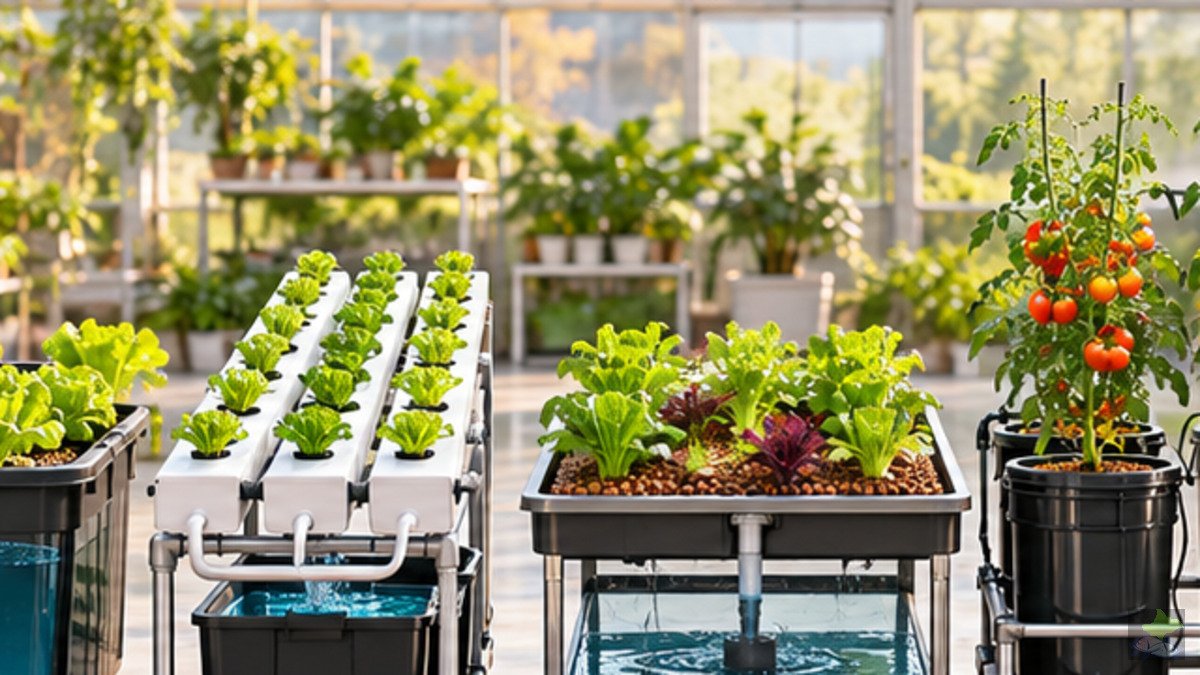
Hydroponic systems · Intermittent irrigation
Ebb and flow system
The root zone controls flooding, completely draining and deriving each cycle from the plant, substrate and climate.
Orientation
Content
- 01Definition and delimitation
- 02Functional principle and cycle
- 03System variants
- 04Components and tasks
- 05Flood depth and drainage
- 06Determine timing correctly
- 07Substrates and containers
- 08Hydraulic design
- 09Reservoir and nutrient solution
- 10Culture management
- 11Monitoring
- 12Hygiene and biofilm
- 13Disorders and diagnosis
- 14Failure safety
- 15Suitability and limits
- 16Planning checklist
- 17Practical conclusion
- 18Specialist sources
Technical chapters 01
Definition and delimitation
Ebb and Flow – International ebb and flow or Flood and drain – is an active, mostly recirculating hydroponic system. A pump temporarily lifts nutrient solution from a reservoir into a floodtub. After reaching the target level, it flows back; the root zone remains moist but not permanently submerged.
Nutrient supply occurs during the flooding phase. Gas exchange is promoted during dewatering and in the flood-free period. The system is neither DWC with permanently immersed roots nor NFT with continuous thin film.
Intermittent
The water level rises and falls in defined cycles.
Recirculating
The collected solution is reused in a controlled manner.
substrate guided
The pore space and water holding capacity characterize the cycle.
Technical chapters 02
Functional principle and cycle
A complete cycle shall include flooding, where appropriate a short holding period, controlled drainage and a drying interval. Not the watch alone decides: culture stage, perspiration, root mass, temperature, humidity, container height and substrate must be considered together.
reservoir
Floods: The pump lifts nutrient solution into the culture table. The level rises up to the structurally limited overflow height.
System graphics 01
Hydraulic cycle

Technical chapters 03
System variants
The term refers to a watering principle, not just a design.
Flood table
Pots, growing plates or stone wool blocks stand in a flat tub. Flexible, but dependent on flatness.
Substrate tray
The trough is completely filled with a structurally stable medium. High buffer action, higher weight and cleaning effort.
Individual pots on the collection line
Several vessels are flooded from below. Modular, but sensitive to different heights and resistances.
Tidal vessels
A control container fills connected planters. Well scalable, technically more complex.
Technical chapters 04
Components and tasks
Lightproof, accessible and with reserve for complete return.
Select by real volume and volume flow, not just by nominal value.
Dimensionally stable and flat, without permanently remaining puddles.
Sufficient cross section, detachable and protected against particles.
Mechanically limits the tide height and protects the root neck.
Reliably drains the pump flow and runs completely empty.
Switches reproducibly and with suitable time resolution.
Protects pump and lines without becoming a hidden bottleneck.
Technical chapters 05
Flood depth and drainage
The maximum flow height is constructively limited by overflow or standpipe. It is intended to wet the substrate capillary without permanently wetting crowns or stem base. Different pot heights on the same table therefore easily lead to opposing results.
Residual water points promote algae, biofilm and mosquitoes. Table gradient, run-off points and deformation must therefore be tested in practice.
Technical chapters 06
Determine timing correctly
A blanket rule such as “15 minutes every two hours” is not a reliable interpretation. Pump output, tank volume and return time already determine what this time means hydraulically.
with high perspiration, small amount of substrate, low water retention or dense root mass – as long as oxygen supply and return work.
in a cool climate, high atmospheric humidity, water-retaining substrate or small plants – provided the bale does not dry out.
Start conservatively, measure moisture course and plant reaction, change only one manipulated variable and observe several cycles.
Technical chapters 07
Substrates and containers
The substrate is a water reservoir, air pore system and mechanical anchorage. Decisive factors are air capacity, water holding capacity, capillary capacity, structural stability and particle size.
Technical chapters 08
Hydraulic design
The pump must deliver the moving volume to the highest point within the intended flooding time. Catalogue values at zero funding height are not enough.
Flood volume
Useful area × water level, less displacement.
Heading
Height difference plus losses in lines and valves.
Return reserve
Overflow and return control the real pump flow.
The reservoir must retain sufficient residual volume for the pump during flooding and must receive the entire mobile plant volume plus reserve during return.
Technical chapters 09
Reservoir and nutrient solution
The reservoir remains light-tight, protected from temperature and accessible. water losses shall be replaced with appropriate source water; Nutrient losses cannot be derived from the water level alone.
Technical chapters 10
Culture management
Young plants have little root volume and may not reach the capillary fence yet. As the leaf area increases, the consumption increases; with more dense rooting, the storage capacity and the sequence change.
-
01Growing
Ensure contact between the growing cube and the wet zone without flooding the root neck.
-
02Vegetative growth
Track the cycle based on daily cycle, root pattern, pot weight and drainage.
-
03High load
Test reservoir reserve, pump power and peak load temperature.
-
04Cultural change
Remove residues, open lines, clean surfaces and document release.
Technical chapters 11
Monitoring
A single value shows only one moment. The operation is meaningful by the same measurement times and the joint consideration of EC, pH, temperature, filling level, flooding time and return time.
After mixing at the same time of day.
Deviations show hydraulic problems early on.
Document colour, smell and residual water.
Technical chapters 12
Hygiene and biofilm
Recirculation distributes water and nutrients, but also potentially root pathogens. Light closure, complete drainage and cleanable components are therefore design features.
Algae are formed where light meets nutrient solution. Lightproof coverings and dry surfaces are the first barrier.
Technical chapters 13
Disorders and diagnosis
Verify hydraulics and measuring devices, then test a hypothesis. Uncoordinated changes destroy the diagnostic basis.
Technical chapters 14
Failure safety
A power failure stops the watering, but does not cause flooding if the return flow is correctly designed. The moisture reserve in the substrate is critical – often shorter in the case of heat and large plants than in the daily average.
Limit maximum levels independently of timer.
monitor the level, pump flow or level increase.
Pump, timer and connections.
Practically determine under the most unfavourable climate.
Technical chapters 15
Suitability and limits
Strengths
- Flexible cultural formats
- uniform underwatering
- Good accessibility
- Recirculating leadership
- Pronounced wet/air phases
Boundaries
- Depends on the pump and timer
- common solution as a hygiene connection
- Residual water at uneven tables
- Climate and substrate-dependent timing
- Large mobile plant volume
The principle is particularly suitable for young plants, herbs, leaf and pot cultures. Large fruit crops require suitable carrying capacity, vessel volume and root zone.
Technical chapters 16
Planning checklist
Technical chapters 17
Practical conclusion
A good ebb-and-flood system is not recognized by an often copied timer value. It is recognized by the fact that flooding volume, pump characteristic curve, overflow, return flow, substrate and plant requirements are designed and operated in a coherent and measurable manner.
The flood phase is supplied. The drainage is ventilated. Only controlled repetition makes it a stable production process.
Traceability
Specialist sources
The site combines the systematics of Vida Vertical with publicly accessible university and government sources. Numerical values must always be validated culture-, climate- and plant-specific.
- Q01: Oregon State University Extension, Hydro hints: Ebb and flow. Open original source
- Q02: Oklahoma State University Extension, Hydroponics. Open original source
- Q03: New Mexico State University, Water-saving Farming for New Mexico’s Arid Environment. Open original source
- Q04: Oklahoma State University Extension, Electrical Conductivity and pH Guide for Hydroponics. Open original source
- Q05: Oklahoma State University Extension, Soilless Growing Mediums. Open original source
- Q06: Penn state extension, Pythium. Open original source
- Q07: Penn state extension, Sources of Plant Disease in Greenhouses. Open original source
- Q08: Oklahoma State University Extension, Algae Control for Greenhouse Production. Open original source
- Q09: Virginia Cooperative Extension, What is Controlled Environment Agriculture?. Open original source
- Q10: FAO Knowledge Repository, Small-scale aquaponic food production. Open original source