
HYDROPONIC SYSTEMS · PASSIVE SUBSTRATCULTURE
wicking system
Feed nutrient solution without a water pump capillary into the root zone and plan wick, substrate and plant requirements as a coherent supply system.
ORIENTATION
Content
A low technical effort does not automatically mean a large area of application. The decisive factor is whether the capillary subsequent delivery securely covers the peak consumption.
Definition and classification
A hydroponic wicking system supplies a substrate from a lower reservoir. An absorbent material connects both areas; the nutrient solution rises by capillary action against gravity.
It is a Passive system: Neither water pump nor timer is required for liquid transport. “Passive” does not mean maintenance-free. Concentration, water level, hygiene and consistency of the wick remain operational sizes.
The absorbed solution does not flow continuously back to the tank. This makes the system fundamentally different from NFT, Ebb and Flood or Dutch Bucket.
A wicking system is not automatically “closed”, “lossless” or “self-regulating”. It's just pumpless. Evaporation, plant uptake and salt accumulation remain.
Functional principle: from reservoir to root zone
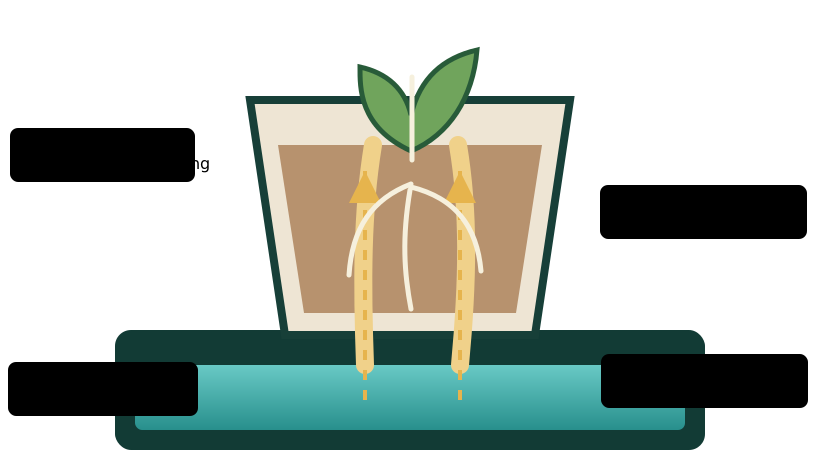
The lower wick end is permanently in the nutrient solution.
Adhesion and cohesion move solution in fine pores upwards.
The wick releases solution to the moist substrate.
Plant uptake produces the driving moisture gradient.
Components and their actual task
Reservoir
Lightproof, cleanable and sufficiently large. It buffers water and concentration fluctuations.
wick
Cross section, fiber structure, length and ageing determine the subsequent delivery.
Planting vessel
Separates substrate and supply and keeps the hydraulic geometry stable.
Substrate
Distributes moisture, supports the plant and must at the same time retain air pores.
Capillarity – the crucial system boundary
Fine pores allow for greater rise heights, but often limit the flow rate. For practice, therefore, not only whether a wick "gets wet", but which Production under real plant consumption arrives.
- Short, wide wicks usually deliver more robust than long, thin ones.
- More cross section can wet the substrate.
- Dehydration can interrupt the liquid path.
- Salts, biofilm and root growth change performance.
Select and test wick material
| Material | Wetting | Durability | Classification |
|---|---|---|---|
| Polyester/nylon band | good after pre-wetting | High | Dimensionally stable, easily reproducible |
| Synthetic fibre cord | material dependent | High | only after funding test |
| Cotton | very good | Limited | Check more often |
| Glass fibre | Good | High | Only suitable products can be safely processed |
24-hour preliminary test
- Pre-wett the wick completely with the subsequent nutrient solution.
- Planned height difference, length and substrate contact.
- Weigh delivery quantity – not just assess “wet”.
- Plan a safety reserve against peak demand.
Substrate: Distribute moisture, obtain air pores
Root, moisture and oxygen zones
Very coarse materials can create an uneven humidity zone; Very fine, strongly water-retaining mixtures displace air. Decisive is the interaction of wick, grain, pore volume, pot height and culture.
Qualitative planning representation, no universal measured values. Product, grain, compaction and mixing change behavior.
Dimensioning: Requirement instead of rule of thumb
Dimensioning over a funding test
vessel size, leaf area, light, air movement and stage of development.
Measure with real nutrient solution, feed height, material length and substrate.
Expect warm, bright days and aging – not the average.
“One wick per plant” is not a technical interpretation. Optically identical cords can convey very different amounts.
Nutrient solution and water quality
A complete hydroponic fertilizer is used. Starting water and manufacturer dosage form the starting point. In the passive tank, plant uptake and evaporation change the ionic ratios – the EC alone does not show which nutrients are missing or accumulating.
The lower end must not fall dry.
Light promotes algae and changes the oxygen balance.
Do not endlessly re-pour fertilizer.
pH, EC, temperature and oxygen
Observe drift; first measure, then correct carefully.
Rising EC with decreasing level often speaks for concentration.
Warm solution binds less oxygen.
Moisture must not completely fill the air-carrying pores.
There is no universal pH or EC value for “the wicking system”: culture, phase, water and fertilizer formulation determine the working range.
Construction and commissioning in nine steps
Take-off status and safe entry into service
- 01Select food-grade, light-tight and cleanable containers
- 02Set low head and safe air gap
- 03Cut wicks with sufficient immersion depth
- 04Pre-wetting the wick and substrate completely
- 05Spread the wick flat in the lower root zone
- 06Prepare nutrient solution as specified by the manufacturer
- 07Openings to shield against light
- 08Test empty before planting
- 09Connect moist bales of young plants to the supplied zone
Operation and proper refilling
Refill decision instead of blank dosage
- Plant tension and leaf position
- wick contact with water
- Leakage, odour, haze
- Level, pH and EC as course
- Substrate moisture above and below
- Root neck permanently wet
- Tank and wick inspect
- Documenting deposits
- Renewing the solution depending on the state
If the level falls and the EC rises, water is usually to be supplemented first. If the EC falls, this does not automatically result in any fertilizer redosing.
Suitable cultures – and unsuitable expectations
Culture course and increasing water demand
Herbs & compact leaf cultures
Basil, mint, parsley, small lettuce and Asian leaf types.
Small ornamental and experimental cultures
Good for training and small self-sufficient vessels.
Large crops
Tomatoes and cucumbers often exceed passive production limits quickly.
Defect diagnosis: Symptom → Examination → Measure
Diagnostic chain for typical disorders
| Symptom | First check | Targeted action |
|---|---|---|
| Wilting despite a full tank | Wet wick? Funding path? Root neck? | rewetting; Correct height/section; Check the roots. |
| Substrate clapping wet | Too many wicks? Too fine a mixture? | Reduce promotion; producing an air-conducting structure. |
| Leaf border necrosis | EC plot, pH, temperature, salt crust | Do not fertilise blind; Measure cause, renew solution if necessary. |
| Algae | Light incident on the tank or substrate | exclude light; Clean the affected areas. |
| Fatty odor | Roots, organic residues, temperature | Remove infestation; clean; Correct air/moisture guidance. |
Hygiene, materials and food safety
Protect open reserves and use water appropriately for use.
No unknown fibres or unsuitable recycling containers.
Keep the wick, tank and planter inspectable and interchangeable.
Keep nutrient solution away from edible plant parts and tools.
Hydroponics is not germ-free. Moisture, nutrients and warm surfaces can promote biofilms.
Structures and meaningful variants
Single vessel
A tank, a pot, one or more wicks. Easy to observe.
Capillary mat
Surface distribution to several vessels; Evenness and contact are critical.
Self-watering pot
Integrated reservoir, often with substrate column as capillary bridge.
Hybrid with ventilation
Air pump ventilates the tank; the liquid transport remains passive.
Direct system comparison
Transport principles clearly separated from each other
| Characteristic | wick | Kratsky | DWC | NFT | Ebb and Flood |
|---|---|---|---|---|---|
| Transport | Capillary | Root contact | Root contact | Pump flow rate | Interval flooding |
| Substrate | Medium | Small | Small | Very low | Medium-high |
| Electricity for transport | No | No | No | Yes | Yes |
| Critical failure | wick limit | Levels | Ventilation | Flow rate | Pump/timer |
| Scaling | Limited | Limited | Good | Good | Good |
Limits, scope and scale
The strength is the simplicity. The same simplicity limits the controllable mass flow.
Peak consumption cannot be compensated arbitrarily.
More promotion increases the risk of a low-oxygen root zone.
No active mixing; local salt gradients are possible.
Many individual vessels increase control and cleaning effort.
Planning checklist and specialist sources
Check before take-off
Selected primary and specialist sources
- University of Illinois Extension: Home HydroponicsSystem classification and passive wick supply
- New Mexico State University: Water-saving FarmingConstruction and Limitations of Wicking Systems
- Oklahoma State University Extension: HydroponicsPassive and active systems, capillary action
- Oklahoma State University: Soilless Growing MediumsProperties of hydroponic substrates
- USDA National Agricultural Library: HydroponicsDefinition and additional resources
- U.S. National Park Service: HydroponicsSystem types and oxygen access
Editorial note: Documented system basics are separated from planning heuristics. Qualitative bars are not measured data; pH and EC values are not erroneously output as universal system values.